Glossary
From Ezekiel 4:9 to live enzymes to Genesis 1:29 to yeast free: a glossary of terms and phrases that help illustrate Food for Life’s commitment to bakery products made with the finest natural ingredients to provide optimum nutrition and maximum taste.
A
A bread allergy is usually caused by a wheat allergy which is an abnormal response of the body to gluten, a protein found in wheat. Wheat products are in many foods. Gluten refers to a group of proteins that are difficult for humans to digest. One group of proteins called gliadin is thought to do most of the damage to the intestinal lining. Glutenins are another group of proteins found in gluten and often associated with autoimmune skin diseases and asthma. Gluten proteins are extremely resistant to intestinal digestion, despite grinding, cooking, processing and digestion. To avoid foods that contain wheat, it is important to read food labels.
B
C
"Certified Organic" means the item is grown according to strict uniform standards that are verified by independent state or private organizations. Certification includes inspections of farm fields and processing facilities, detailed record keeping, and periodic testing of soil and water to ensure that growers and handlers are meeting set standards.
D
E
White bread is enriched with the four major B vitamins - niacin, thiamin, folic acid and riboflavin - and iron in equal amounts to what was removed with the bran and germ. Milling grain into white flour requires the removal of the bran and the germ. By contrast, Food For Life sprouted breads are made from freshly sprouted grains which contain all the fiber, bran, vitamins and minerals of the original grain plus an average of nearly 100% increase in those vitamins and minerals.
4:9-17 The bread which was Ezekiel's support, was to be made of coarse grain and pulse mixed together, seldom used except in times of urgent scarcity, and of this he was only to take a small quantity. Thus was figured the extremity to which the Jews were to be reduced during the siege and captivity. Ezekiel does not plead, Lord, from my youth I have been brought up delicately, and never used to any thing like this; but that he had been brought up conscientiously, and never had eaten any thing forbidden by the law. It will be comfortable when we are brought to suffer hardships, if our hearts can witness that we have always been careful to keep even from the appearance of evil. See what woful work sin makes, and acknowledge the righteousness of God herein. Their plenty having been abused to luxury and excess, they were justly punished by famine. When men serve not God with cheerfulness in the abundance of all things, God will make them serve their enemies in the want of all things. (Source: Matthew Henry's Concise Commentary on the Bible)
F
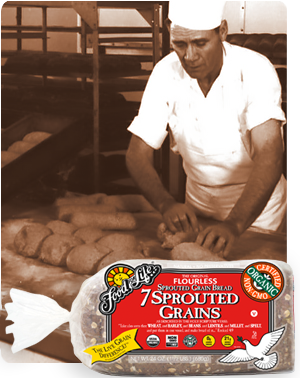
We start with certified organically grown whole grains. After sprouting, they are made into small batches of dough and slowly baked into bread.
G
1:29 And God said, Behold, I have given you every herb bearing seed, which is upon the face of all the earth, and every tree, in the which is the fruit of a tree yielding seed; to you it shall be for meat. (Source: Wesley's Notes)
Genetically Modified Organisms
Although "biotechnology" and "genetic modification" are used interchangeably, GM is a special set of technologies that alter the genetic makeup of such living organisms as animals, plants, or bacteria. Biotechnology, a more general term, refers to using living organisms or their parts, such as enzymes, to make products that include wine, cheese, beer, and yogurt. Food For Life forbids the use of genetically altered ingredients in its products. Food For Life uses only natural ingredients from suppliers which are certified organic or have non-GMO verification. To that end, we make the following statement: “To the best of our knowledge, Food For Life products do not contain GMOs.”
For non-dormant seeds, germination starts when a seed is watered, as long as the temperature is suitable. The uptake of water by dry seed is called imbibition (imbibition means to drink: seeds imbibe water, you do not imbibe seeds). As seeds imbibe water, they expand and enzymes and food supplies become hydrated. Hydrated enzymes become active and the seed increase its metabolic activities to produce energy for the growth process. In addition, the water causes turgor pressure to increase in the cells and they are able to enlarge.
Gluten is a general name given to the storage proteins (prolamins) present in wheat, rye, barley, and oats. Products labeled as being “Gluten Free” removes contents containing wheat, rye, barley, and commercial oats. The storage proteins of corn and rice do not contain the toxic cereal prolamins and are not harmful to individuals with Celiac Disease. Foods labeled as gluten-free in
Not all carbohydrate foods are created equal, in fact they behave differently in our bodies. The glycemic index or GI describes this difference by ranking carbohydrates according to their affect on our blood glucose levels. Choosing low GI carbs - the ones that produce only small variations in our blood glucose and insulin levels - is the secret to long-term health reducing your risk of heart disease and diabetes and is the key to sustainable weight loss. (Source: Human Nutrition Unit, School of Molecular and Microbial Biosciences,
H
Healthy eating includes plenty of fiber – which means getting 21 to 38 grams each day. Fiber is the part of plant foods that your body cannot digest. Fiber is what puts the bulk in salads, the crunch in carrots and broccoli and the chewiness in whole grain breads. There are two types of fiber: insoluble and soluble. (Source: Canadian Cancer Society)
I
This fiber cannot be digested by our bodies, but it does provide bulk to the stool to help prevent constipation. It also helps you feel full. Sources of insoluble fiber are whole grain breads and cereals, brown rice, and vegetables and fruit. Whole grains are rich in vitamins, minerals and phytochemicals. They contain several substances that have each been linked to a lower risk of cancer. (Source: Canadian Cancer Society)
J
K
L
About 75% of the enzymes necessary for digestion come from foods in the diet and the other 25% are produced by the body. High concentrations of hydrochloric acid secretion in the stomach, stress, poor diet, illness, colds and fever, caffeine and alcohol consumption, dieting, job stress, medications, extreme weather, inadequate sleep and other lifestyle and environmental factors destroy digestive enzymes. Live enzymes are in raw foods, fruit, vegetables, grains, and nuts. Our sprouted grain breads are not necessarily a source for "Live" enzymes. What's important to remember is the natural enzymes in the grains are activated during the sprouting, which releases the nutrients. The enzymes do their job before the grains are made into bread.
Through the sprouting process the grains become living, nutrient-rich, food. It is these "live" grains we use to make our breads. Different from other breads, we sprout all the grains used in our bread before using them in our products. During our unique sprouting process, enzymes are released from the germ of the grain.
The Glycemic Index (GI) ranks carbohydrate-rich foods according to their glycemic response. Foods that raise your blood glucose level quickly have a higher GI rating than foods that raise your blood glucose level more slowly. In general, the lower the rating, the better the quality of carbohydrate. Not only do low GI foods raise your blood glucose more slowly and to a less dramatic peak than higher GI foods, but most low GI foods are all-around healthier choices. Low GI foods are usually lower in calories and fat, while also being high in fiber, nutrients and antioxidants. Choosing low GI foods more often may help you increase levels of HDL (healthy) cholesterol in your blood and might help you control your appetite, as they keep you feeling fuller, longer. (Source: Canadian Diabetes Association)
M
Malting is a process applied to cereal grains, in which the grains are made to germinate and then are quickly dried before the plant develops.
N
O
Mild-flavored barley grain contains some gluten. It is low in fat. Aside from being used in baked goods, barley flour can also be used as a thickener, much like flour, for people on a wheat-restricted diet.
The millets are a group of small-seeded species of cereal crops or grains, widely grown around the world for food and fodder. Flour made from hulled, organic millet produces very light baked goods with a distinctive flavor.
P
A substance found in many foods that come from plants, including corn, wheat, rice, and soybeans, and in large amounts in cereals and legumes. It is being studied in the prevention of cancer. Also called inositol hexaphosphate (IP6).
Q
R
Unprocessed food based on fruits, vegetables, nuts and seeds, with its benefits for physical, mental, emotional and spiritual health, animals and the environment.
S
Sea salt is a broad term that refers to unrefined salt derived directly from a living ocean or sea. It is harvested through channeling ocean water into large clay trays and allowing the sun and wind to evaporate it naturally. Manufacturers of sea salt typically do not refine sea salt as much as other kinds of salt, so it still contains traces of other minerals, including iron, magnesium, calcium, potassium, manganese, zinc and iodine.
Our bodies can partially digest this fiber. Soluble fiber may help to lower blood cholesterol. Sources of soluble fiber are oats and legumes. Examples of legumes: beans: black, kidney,
Sprouted grains grow into young plants before mashing and baking. They offer a healthy alternative to regular breads. By allowing a grain to sprout many more nutrients are available as the grain becomes a living plant. Sprouted grain breads have different properties from nonsprouted grains. Most notably they have no need for any fortification of vitamins or minerals as they are rich in these nutrients. Sprouted grains also offer a complete protein, something rare among grain products. They are mostly free of gluten and can often be tolerated by gluten sensitive people. Sprouted grains are also more alkaline than the acid forming nonsprouted grains.
T
Trans fats (trans fatty acids [TFA]) are produced by partial hydrogenation of unsaturated vegetable oils to improve the properties of the fat in certain foods. TFA are also naturally present in milk and meat from ruminant animals. The TFA from animal sources have no associated risk and provide health benefits. The TFA from hydrogenated oils have been connected to increased heart disease. Food For Life Breads do not contain TFA's.
U
Unprocessed bran is pure wheat bran. It is an excellent source of fiber. It has no cholesterol or sodium and is a low-fat and convenient way to add fiber to a healthy lifestyle.
V
W
X
Y
Yeast, or Candida Albicans, is sometimes considered to be a major contributor of many states of chronic illness.


